
Monday, December 6, 2010
Rick Lacy: Back to School!
Rick Lacy: Back to School!: "Class will be in session starting January 2011! Hey everyone, my private character design class at Bergen Street Comics www.bergenstreetc..."

Monday, November 29, 2010
KGB Bar - Live Comics Reading
On Sunday Night I dropped by KGB Bar in the East Village to check out the vaguely listed Comix and Graphic Novelists. About the Series: KGB Bar Sunday Night Fiction. The KGB Bar Sunday Night Fiction showcases the finest in contemporary fiction from new and emerging writers.
I knew Emily Wernet had done a turn back around when I reviewed her comic 'Moonlighting', but other than that I hadn't heard of it or where I could get info. Afterwards I stumbled across Tom Hart's blog, the organizer and teacher of cartooning, which provided me with the names of the night's artists and their spots on the web.
Just as an aside, I have one of Tom Hart's 'Hutch Owen' books and I really dug it, one of my first indie cartoonist books I ever bought.
So I stumbled in with my girlfriend Laura Lee (on our third anniversary, and yes, that's months thank you), grabbed a Baltika, a huge Russian beer that is, and we tried not to stand in the way. I had no idea who was going to come out, but I recognized Alex Robinson in the corner, so I knew this would be good.
(I love Box Office Poison and have a sketch inside my copy, hell yeah.)
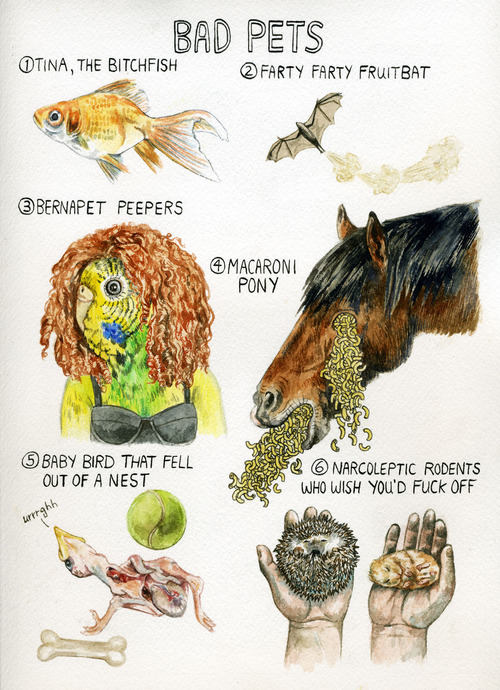
First up came Lisa Hanawalt, who you can meet tonight at Desert Island Comics in Williamsburg as she signs at her launch party for I Want You #2 and her window display at Desert Island.
She warmed up the crowd with her twisted lists from Bad Pets, to Awesome Hats, and How To Tell Martha Stewart's Drunk. Her art style is a wonderfully chaotic balance of fine line illustration and madcap absurdity, bordering on the grotesque at times, though always able to provoke, often into laughter.
Next up was Mike Dawson who was sitting over by Alex Robinson, and I guess that makes sense as they have very similar sensibilities.

He read a selection from his comic Troop 142 which is about as accurate a portrayal of young male life in America as I've seen. It's juvenile and possibly even nonsensical, but absolutely genuine and pure in its delivery of innocence as it lingers for those last few years before being a teenager truly kicks in.
Then there was a brief intermission so we could grab more beers. After we were settled in, then came the closer...Kate Beaton ladies and gentlemen!
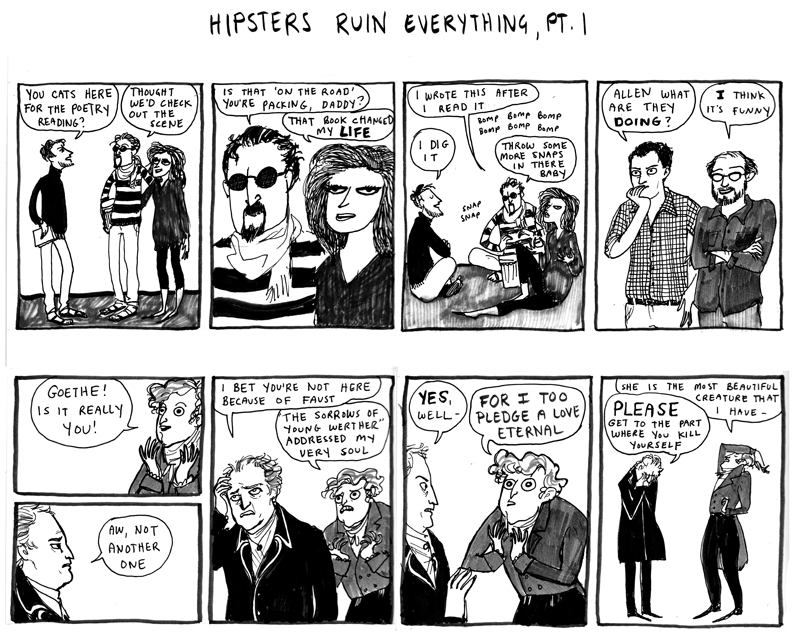
I mean, if there's a cartoonist out there that has more buzz on them besides Kate Beaton, well then point them out dammit! From her Aquaman which has made the rounds on Tumblr, the Gatsby's, the Mystery Solving Teens...I mean, just go to her site and prepare to lose at least an hour as you take it all in. It's consistently funny, in the art style, and delivery of every punchline. You know what's even better than that though? Having Kate herself deliver the lines. Her voice, perfectly gravelly and deadpan as she hits every beat, knowing her strips through and through.
This was definitely a great event that I'd like to see more often than just every three months. Let me see what I can do, maybe wrestle up a venue, certainly know enough artists that'll show their work. Hmmmm...
In the meantime, check out these artists, as all are very top notch indie creators, and come swing by Desert Island tonight and say hello.
K
Twitter
Lisa Hanawalt
Mike Dawson
Kate Beaton
I knew Emily Wernet had done a turn back around when I reviewed her comic 'Moonlighting', but other than that I hadn't heard of it or where I could get info. Afterwards I stumbled across Tom Hart's blog, the organizer and teacher of cartooning, which provided me with the names of the night's artists and their spots on the web.
Just as an aside, I have one of Tom Hart's 'Hutch Owen' books and I really dug it, one of my first indie cartoonist books I ever bought.
So I stumbled in with my girlfriend Laura Lee (on our third anniversary, and yes, that's months thank you), grabbed a Baltika, a huge Russian beer that is, and we tried not to stand in the way. I had no idea who was going to come out, but I recognized Alex Robinson in the corner, so I knew this would be good.
(I love Box Office Poison and have a sketch inside my copy, hell yeah.)
First up came Lisa Hanawalt, who you can meet tonight at Desert Island Comics in Williamsburg as she signs at her launch party for I Want You #2 and her window display at Desert Island.
She warmed up the crowd with her twisted lists from Bad Pets, to Awesome Hats, and How To Tell Martha Stewart's Drunk. Her art style is a wonderfully chaotic balance of fine line illustration and madcap absurdity, bordering on the grotesque at times, though always able to provoke, often into laughter.
Next up was Mike Dawson who was sitting over by Alex Robinson, and I guess that makes sense as they have very similar sensibilities.
He read a selection from his comic Troop 142 which is about as accurate a portrayal of young male life in America as I've seen. It's juvenile and possibly even nonsensical, but absolutely genuine and pure in its delivery of innocence as it lingers for those last few years before being a teenager truly kicks in.
Then there was a brief intermission so we could grab more beers. After we were settled in, then came the closer...Kate Beaton ladies and gentlemen!
I mean, if there's a cartoonist out there that has more buzz on them besides Kate Beaton, well then point them out dammit! From her Aquaman which has made the rounds on Tumblr, the Gatsby's, the Mystery Solving Teens...I mean, just go to her site and prepare to lose at least an hour as you take it all in. It's consistently funny, in the art style, and delivery of every punchline. You know what's even better than that though? Having Kate herself deliver the lines. Her voice, perfectly gravelly and deadpan as she hits every beat, knowing her strips through and through.
This was definitely a great event that I'd like to see more often than just every three months. Let me see what I can do, maybe wrestle up a venue, certainly know enough artists that'll show their work. Hmmmm...
In the meantime, check out these artists, as all are very top notch indie creators, and come swing by Desert Island tonight and say hello.
K
Lisa Hanawalt
Mike Dawson
Kate Beaton
Thursday, November 11, 2010
CASANOVA Review
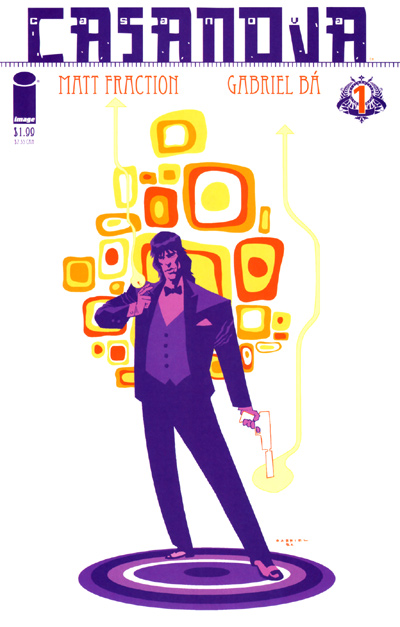
CASANOVA
by Matt Fraction and Gabriel Ba
What the FUCK did I just read? It's like old Marvel 'Nick Fury, Agent of SHIELD' comics thrown in a blender with Grant Morrison's 'Invisibles' then trying to repaint Michael Moorcock's Jerry Cornelius books. Granted it's all done with Matt Fraction's indelible wit and chock full of chunky ideas and action packed segments.
It's an attractive hardcover, with a 60's-70's vibe plastered all over it, from the trippy color palate and stark design, to the moody Paul Pope/Nick Cave-ish face of Casanova himself. It's quite unlike any other book out there in packaging, if not concept, but it comes with a hefty price tag of $24.99. Is it worth that?
Not really. The gags and action are quite awesome, and the general concept of a time swapped thief turned superspy caught between various warring factions, well that's just all kinds of awesome, tossing in all the things I love. But it really tries to be too clever. The plot is all over the place and I find myself trying to work out what happened and it really is nearly incomprehensible.

And I'm a well trained comic book reader here folks, with twenty years of experience, so I know what I'm talking about. The story has its moments, and the clever ideas are indeed quite clever, and mostly well executed, but the rest inbetween, that little thing we call the plot, it's about as flimsy as it comes.

It reminds me a lot of Fraction's earliest comic, 'Rex Mantooth' from Planet Lar/AIT, which featured a giant talking gorilla supersecretagent in a tuxedo that was illustrated by the lovely Andy Kuhn, and was also chock full of fun (especially the annotated Mantooth which has a running commentary beside each page). But where that was goofy and played it, I feel like Casanova wanted to be taken a bit more seriously, and it falls short.
Granted it does play with the spy tropes and throws in a lot of comic book idioms, but really it's just a big mess of a story with tasty bits. Now, the artwork is quite stunning, and even though the single color shading throughout took some getting used to, it was cool to see something new and when it worked, it worked well. I never was lost to what was happening visually. Just I didn't quite follow the leaps in logic and story structure.
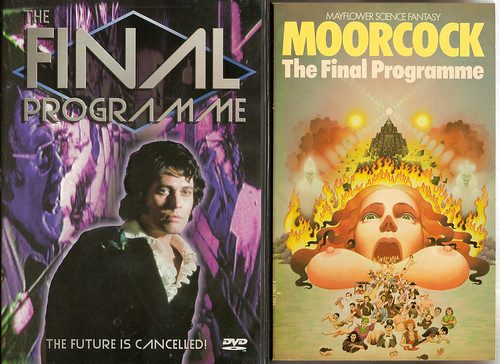
Now, similar critiques could be made about Moorcock's Jerry Cornelius stories, which I love more in theory than practice, but at least he was out there doing it first. Instead this story feels like a cross between a failed pulp novel and an old SHIELD pitch for Marvel with a few hip ideas swiped from today's more polished and esoteric writers.
This isn't a Fraction bash-fest mind you. When the man is on, he's on. His work on Iron Man started rough but rose to brilliant levels, and the previously mentioned 'Rex Mantooth' was thoroughly enjoyable. Maybe I just had high expectations from the concept for the story (sexy superspy sci-fi pulp) and the reviews of it from friends who've read it.
All in all, it wasn't NOT worth reading, and it does set things up in the end (the rather blunt and abrupt ending that wraps up NOTHING) that could potentially make for a really cool second attempt at telling this type of story, but this arc I would consider a failure, and as all spies know, failure will not be tolerated.
I give you all license to kill this book from your reading list.
K
Thursday, November 4, 2010
Warren Ellis' "On What Comics Can Do"
Warren Ellis has long been a champion of the power of the comic format, and has often delved into the--sometimes very technical-- act of creating a story using words and pictures. His GLOBAL FREQUENCY series was somewhat of an exercise in matching specific types of stories with specific artists, and a well done exercise at that. In fact, Ellis goes to great lengths to match all of his projects with artists that he feels maximize the storytelling.
What do you think? How are comics different than film? How are they different from prose? Let us know in the comments.
Explaining why comics are important to people who have only a passing knowledge can sometimes be frustrating, but Ellis is in the process of breaking down the distinctions between comics, prose and film. He posted this bit on his site Warrenellis.com.
For the last three months or so, I've been working piecemeal in spare time on a short booklet about writing comics. Here's one small piece of it, the beginning of a section:
In what ways are comics not like film, you ask (in my head)?
Illustration creates a suspension of disbelief.
If Art Spiegelman’s MAUS had been filmed first, it would have had an audience of maybe three people at Sundance. Because the moment everyone trooped on wearing their mouse masks, any larger audience would have lost it and left giggling. Only in the space of cartooning could that conceit work. Not least because we’re already aware, when we come to cartooning, that we’re looking at someone’s processed and hermetic perception of the world. The great success of MAUS is that the mouse faces make us let our guard down, and so we’re hit by the horrible truth of that book from an unprotected angle.
There’s a page I often cite in these conversations, from the 1974 comic MANHUNTER by Archie Goodwin and Walt Simonson. It’s an entire Jason Bourne sequence in a single page. In a Marrakesh alleyway, Damon Nostrand is in a car attempting to run down Paul Kirk and Christine StClair. Kirk pushes StClair to cover, rolls under the speeding car, draws a knife, tears it through the car’s petrol tank as it passes over him, gets clear, lights a match, touches it to the trail of petrol the car leaves, the petrol blazes down the alley to the car, the car explodes, and then they do three or four lines of dialogue while watching Nostrand burn to death about how it’s horrible but really he was a bit of a git and completely deserved it. One page. Employing “camera angles” and compositions that even now the likes of Paul Greengrass would go blind trying to replicate.
Also: a curling, snarling Peter Kuper piece can sear the page with its anger in a way that no photorealistic artist will ever be able to communicate. A room drawn by Eddie Campbell will be more real than any snapshot, because his line is almost like handwriting, and has human breath upon it. Dash Shaw’s work may look rough on first look, but stay with it, look at how he conveys the essence of an idea in every panel, and you’ll realise how hard he sometimes works to evoke an entire world with so few elements.
All of which is to say you’re not necessarily hemmed in by realism, or naturalism of any kind. This is a field that combines, on the one hand, the novel and the poem and the slogan and the news story, and on the other hand every stop from pointillism to cave painting. Understand comics as the marriage of word and picture, as simple as that, and you’ll get a sense of how broad the medium’s reach really is.
I’m currently driving my FREAKANGELS artist Paul Duffield mad by making him draw a sequence partly inspired by the main titles of Gaspar Noe’s ENTER THE VOID. Which is all typography and signwork.
Comics are not film. Film can do some things we can’t. But we have a far larger toolbox.
Tuesday, November 2, 2010
Write Club! "Piethos!" V. 3, Ep. 6
Write Club can't always be about comics, right? Right! So in this episode Tim & Kurt take the podcast out into the streets of Brooklyn to cover a Slice Magazine reading event.


The event, coordinated by Slice's resident blog czar and online editor, C.A.B Fredricks was your basic head-to-head reading competition featuring the best and the brightest up & comers of the indie publishing world!
photo courtesy of Amy Sly
PIETHOS! A Reading, works like this: Five independent literary organizations were chosen, each selected a champion, and presented a challenge for an opposing organization. Each reader had about one week to compose a story in answer of their challenge. The prize? A FRESH BAKED APPLE PIE!
The event was held at LEGION bar in Williamsburg, Brooklyn.
Listen to the event here:
And now, THE READERS, with visual aids and in order of appearance:
Liz Matthews (Slice Magazine)
photo courtesy of Amy Sly
Liz's story involved some visual aids. To get the whole experience, click on each link as she prompts the picture in her story.
Corey Eastwood (Book Thug Nation)
photo courtesy of Amy Sly
Kate Axelrod (Featherproof Books)
photo courtesy of Amy Sly
Martha Raoli (Canteen Magazine)
photo courtesy of Amy Sly
The Prize:
photo courtesy of Amy Sly
Now Dear Write Clubbers, after listening to the event, who would YOU have chosen to win the nommy pie?
Sunday, October 24, 2010
Comic Reviews
MARVEL:
Amazing Spider-Man #645:
Superman #703:
American Vampire #6: Stephen King has stepped aside after completing his five issue run so now Scott Snyder is the primary creative force behind American Vampire. How'd he do? Check below for a further review.
ICON:
Nemesis #3:


My pick this week is Scott Snyder's Vampire/Western/History of America book. We still have the continuous issue of the barons of industry fighting the simple folks of the frontier. This time, we're pushed to 1930's in the middle of the depression, and we're introduced to another character: Cashel McCogan. He's the new chief of police, replacing his father who was killed two months prior. The morals have shifted slightly -- there are undercurrents of the evils of drinking, gambling, prostitution, and much of the issue is devoted to the frustrations small towns faced when big businesses came in and built large structures like dams, bridges, or factories. Snyder writes Cashel as part rancher and part bad ass. He uses bucolic phrases like "You and yours," but still maintains an air of control. The story feels big, and I imagine that Snyder must feel like he can sprawl a bit more, now that he's got a full twenty-two pages to play with. This is a great beginning -- Snyder still uses Skinner Sweet (who is easily one of the coolest comic creations), and Rafael Albuquerque still provides the beautiful images to go with Snyder's story. Where readers may have been interested to see if the story loses any of its "oomph" with the departure of Stephen King, I can assure it doesn't. It still has just as much bite as before.
Amazing Spider-Man #645:
This issue of Amazing Spider-Man is noteworthy in that Spidey spends almost the entire issue kicking the crap out of his rogues. Most of his attacks are contrived situations -- his villains happen to be in the right places at the wrong times. But still, Mark Waid knows how to write a cool story. My two favorite moments: Spider-Man tears down a dockside warehouse by pulling the beams apart underwater; Spider-Man chases the Chameleon through a mansion, only to pull him through a wall. All of this is because Peter thinks Norman Osborne and Lilly Hollister's baby is dead, and he thinks he's responsible. The truth will out, obviously, but where others have found this series to be growing stale, I still see it as a continuous solid outing.
DC:
DC:
Superman #703:
I'm still enjoying Superman's trek across America. This story is a bit more cliched than others, however, and the moral is shoved down readers' throats. But, It's still more interesting than watching Superman try to battle some alien menace in Metropolis while at the same time dealing with his "marital issues." I think what Straczynski really wants to do is retcon Superman's previous fifteen years. Since that's damn near impossible, this is the next best thing.
VERTIGO:
VERTIGO:
American Vampire #6: Stephen King has stepped aside after completing his five issue run so now Scott Snyder is the primary creative force behind American Vampire. How'd he do? Check below for a further review.
ICON:
Nemesis #3:
I can't even clearly review this piece of shit. Here are some "highlights:" Nemesis kidnaps Blake Morrow's son and daughter, makes Morrow admit that his son is gay, then he uses Morrow's son's sperm to impregnate Morrow's daughter. Oh, and he "rigged [the daughter's] womb to completely collapse" if they attempt to abort the child. Seriously -- RIGGED A WOMB TO BLOW?!? This is the shittiest piece of shitty shit to ever get shit out.
Superior #1:
Superior #1:
Now, while Nemesis may be a steaming pile, I actually enjoyed Superior. Superior is the story of Simon Pooni, a boy with Multiple Sclerosis who is granted a wish by a space monkey. Again, I can't make this shit up. But the difference here is that where Nemesis is all about flash over substance, Superior has heart. There's a lot to like here -- Millar is writing a story that most people can relate to. How many comic book fans wished, at some point, for super powers? Imagine if they were granted, but not to any douchebag on the street. Instead, they're given to a boy who has every reason to own them. What will he do with them? We'll have to wait and see. But Millar admits that Superior is more "family-friendly," despite the book being littered with four letter words. This is a vast improvement from the work he's been doing in his other comics, and I'm looking forward to seeing what Simon does with his abilities. And by the by, Simon Pooni is the name of a guy who won an eBay auction, the proceeds of which went to buy a bus for a school with special needs students. So Millar isn't a complete asshole -- just a guy who shouldn't be given too much "ego space."
Bannen's Book of the Week:
Bannen's Book of the Week:
American Vampire #6
My pick this week is Scott Snyder's Vampire/Western/History of America book. We still have the continuous issue of the barons of industry fighting the simple folks of the frontier. This time, we're pushed to 1930's in the middle of the depression, and we're introduced to another character: Cashel McCogan. He's the new chief of police, replacing his father who was killed two months prior. The morals have shifted slightly -- there are undercurrents of the evils of drinking, gambling, prostitution, and much of the issue is devoted to the frustrations small towns faced when big businesses came in and built large structures like dams, bridges, or factories. Snyder writes Cashel as part rancher and part bad ass. He uses bucolic phrases like "You and yours," but still maintains an air of control. The story feels big, and I imagine that Snyder must feel like he can sprawl a bit more, now that he's got a full twenty-two pages to play with. This is a great beginning -- Snyder still uses Skinner Sweet (who is easily one of the coolest comic creations), and Rafael Albuquerque still provides the beautiful images to go with Snyder's story. Where readers may have been interested to see if the story loses any of its "oomph" with the departure of Stephen King, I can assure it doesn't. It still has just as much bite as before.
Wednesday, October 20, 2010
Book Club Review: One Hit Wonder by Charlie Carillo
 In our celebrity saturated society even those thought long forgotten, idols from our youth who glimmered for just a summer, leaving us with a singular hit song that resonated in the public sending ripples through the pop culture pool, even they become relevant and interesting once more.
In Charlie Carillo's new book One Hit Wonder, we follow Mickey DeFalco, a Queens native who hit it big with his sappy yet melancholy ballad 'Sweet Days' as he returns home an utter failure and total has-been. In his shoes we feel what it's like to be loved and adored for that one contribution to people's lives.
An aging fan hooking up with her teenage fantasy. Bitter former classmates still toiling at menial jobs at home. The girl that was loved and lost, inspiring those epic refrains. These are the people around Mickey that marvel at his achievement and fall from grace. They hold him at a distance, as something other than themselves.
Through flashbacks we're shown even more moments of awkward celebrity. From playing a cruise ship to kids birthday parties, no indignity is spared, and Mickey just casually walks his way through each of them, only passionate and excitable when clinging to his last shreds of dignity.
There's something to Mickey's boy-like demeanor and passive aggressive nature that really shines in the prose. This feels like a real person who could neatly slide into our pop song past. His parents are peppered with sentimental details that make them so true to life. You can see their past as Mickey grew up in their home.
The whole book is littered with truths. About life, love, family. Just lines tossed out here and there that feel like universal truths, spit out by a wiseass Queens kid in a 38 year old's body. The concept of hitting bottom and trying to resurface, flailing about in inconsistency of actions, taking the easy route when available, this is how people behave.
And then there's lost love. Idyllic in memory, which taints all reality about him, making it all a joke, another tragedy heaped upon the pile. How do you react when all you want is the girl, but instead are given fame and fortune? You self-destruct of course. Spiral to the bottom and find yourself again.
The book is very well written and consistent in its tone, with more than a few twists and turns that feel like the randomness of life, rather than the structure of plot. Not to give spoilers, but there is a happy ending there, but it may not exactly come as you'd think it would.
I have yet to read Carillo's other novels, but from this book I imagine he's got more than just this one song to offer.
Check out Charlie Carillo's website or his other book RAISING JAKE.
Saturday, October 16, 2010
Free Comic of the Week: Vision Machine by Greg Pak

A new feature I'll be having up here on the blog is to present the best of free comic books available online.
First up is Vision Machine by Greg Pak. You can read the comic on Comixology or download the PDF.
Greg Pak has an exclusive interview up on Comics Alliance where he mentions that not only are you able to download/read the comic for free online, but eventually there will be a free print version available as well.
Which is really interesting, having a book put together by money from the Ford Foundation and put out under Creative Commons license which means anyone can expand on the universe created within the pages or is able to remix or mashup the story however they see fit as long as the original source is credited. Truly free creative information. The article also has a lot of interesting points about digital comics and creator royalties.
Which leads me over to another article discussing ICv2's number crunching of digital sales which is ultimately summed up as:
"While the news for print was less than positive, with manga sales facing an estimated 20% drop in 2010, the news for digital comics was very good indeed, with Griepp projecting that digital comics sales would see a more than ten-fold increase this year over last."
And:
"But while manga and graphic novels decline, the real energy and growth has been in digital, which has expanded from a $500,000 market in 2009 to an estimated $6 to 8 million dollars in 2010, a more than ten-fold increase. Quite simply, digital comics are "the fastest-growing part of the comics business," said Griepp."
It's interesting seeing this comic going out into the public, with its theme of free creative information with a donation based payment setup and the Orwellian Big Brother aspect of controlled information. I'm eager to find out which direction both the story within the comic and the story of the growing digital distribution and the role that this free comic plays in that.
K
Tuesday, October 12, 2010
New York Comic Con Mini-Cast: Day 1
Day 1:
This is a short one folks! Kurt, Tim and later Phil, take a walk through the con and are struck with a volley of emotions. The British are killed, and Tim & Kurt ask "What's it all about?"
Luckily they're saved by a girl named Gabby.
Intro: "Four Colored Universe" Metasciences
Outro: "Write Club Theme" Scott St. Pierre
New York Comic Con Mini-Cast: Day 2
Day 2:


Intro: "Kingdom Come" Jay-Z
Outro: "Write Club Theme" Scott St. Pierre
Tim is joined by Pete Lenz, who is having fun. Then Tim tries to find the screaming women, and when that doesn't pan out Pete, Tim and Phil head down to the basement to check out Anime Fest. Apples are eaten, smiles are shared, and perhaps the oddest interview I've ever done takes place.
Seeing as how this is a major comic event, I thought I'd check out Marvel's Cup O' Joe panel. That kicks in at about 7 minutes, and therein you'll hear about some of Marvel Comics upcoming plans. This, of course, was a slide show, so you will not be able to see what they're talking about. Here are some bullet points:
- Marvel to publish at least two CrossGen titles. From the images it looks like they'll be SIGIL and RUSE (penned by Mark Waid).
- Brian Bendis and Michael Oeming will be putting out a creator owned, all-ages book named TAKIO.
- Brian Bendis and Alex Maleev team up to reinvent MOON KNIGHT.
- Marvel + ESPN? I don't know either.
- A teaser of a web-series about Marvel editor Steve Wacker auditioning for the Broadway play based on SPIDER-MAN. I think it's called SPIDER-MAN: WTF am I doing on Broadway? (JOKES!)
Intro: "Kingdom Come" Jay-Z
Outro: "Write Club Theme" Scott St. Pierre
New York Comic Con Mini-Cast: Day 3
Day 3:
LAST DAY OF COMIC CON NY 2010! We start this off with Phil Gelatt, and you can tell that the con has taken its toll on this strong, strong man. We then chat with Nikki Cook about her upcoming book, MEMOIR, written by Ben McCool.
After that we catch up with Reilly Brown to discuss his con sketches and his new ALPHA FLIGHT project. And, finally, Rick Lacy appears on the scene to detail his plans to take his life down to zero, and then build it back up to 11.
If you understand the plan, please let me know.
We end with a haunting scene at the AnimeFest. In my mind, I'm still there.
Intro: "I Am the Law" Anthrax
Outro: "Write Club Theme" Scott St. Pierre
Monday, October 11, 2010
Comics: the Con
written Sunday night at 7pm.
At Botanica, drinking Happy Hour drinks, the con weekend over before it ever began. Boston is probably back in Massachusetts by now, Reilly on his way back to Hoboken, Doug'll be back in Utah by tomorrow, and Khoi (with Heather & baby Gideon) are probably driving back to Pennsylvania at this moment.
I spent all day at the Comicon on Friday which just wore me out. I spent Saturday napping, then went out to the MTV party, after drinking in the New Yorker with Boston, mocking TV shows and spitballing ideas. The MTV party was surreal watching as comic celebs all drunkenly danced to hip hop.
I left with Boston and his friend to hit up the East Village where we fit in some dancing time at Beauty Bar before being denied entry into Lit and winding up at Remedy Diner. I was well and sober by the time we came downtown so the grumpiness took over.
I had talked it over with Tim for a bit before, about how we're these mid-level professionals who have done some comic work but not anyone with any pull or weight. And we're far from fan boys who're blowing money on show exclusive books and statues and toys, waiting on line for an autograph from so and so. Whatever happened to the fun of comics?
I imagine I would only enjoy a con again if I had a small child that I could walk around in costume. For now, I'm making face time with some cool people who are friendly aquaintances but not quite friends. Just biding my time until my books come out and can really join the gang of creators that I know.
My girlfriend's galley copy of her book came out today and she signed free copies. What must that be like for her? After being the sole creator on an epic 192 page graphic novel and having it put out by Abrams, one of the more legit publishers out there, here it was, her first comic come to life. I'm so proud to be with her.
I tried not to let my melancholy affect her, but it came out. It just frustrated me to not be able to soak up all the con had to offer and feel invigorated. To be able to acknowledge that the industry is growing and so every show gets bigger and bigger. Why can't I look into that crowd and see anything positive?
All I see is sadness, loneliness. Imagination packaged as product and slapped with a price tag. Looking to my future I see long weekends hocking my wares to an inclusive audience jaded by an oversaturated market. Please buy what I helped create. Give me money so you can distract yourself for a moment. Live someone else's adventure for a snippet of time.
Why can't I look at it as enjoyment of entertainment? Maybe because I don't enjoy it anymore. Every comic I read is research. I've dissected the medium to the point where I see all the behind the scenes movements, and so I never let myself be absorbed by the story.
That just sucks. I've loved comics to the point where it became my identity, then I assumed it needed to be my career, because what else would I do? After crafting a graphic novel I know fully what goes into creating every single comic page. Something someone will pass over in a minute or less.
But hopefully the sum of the parts will be more long lasting. I can really only believe that the total story will move someone, inspire someone, at the very least entertain someone. I don't know though, is that enough? Is that what I want? To spend so much time creating something that people will consume like a snack?
I want to make a bigger impression upon the world. To write something of substance that makes a difference. I know that through story and characters you can make a bigger impact rather than straightforwared dry instructional text. But when it comes to making a living, getting paid for your work, you need to think of the market, the audience's money, and giving them what they want.
The fine line between honest artistic expression and formulaic fluff entertainment, that's what I have a problem with. I just can barely afford to feed myself, let alone spend money on something that I'll read once, so any story put out there needs to be epic. Though new stories need to be created all the time to feed the pop culture machine as it reaps the dreams of people, nuturing the dreams of others.
Maybe I'm overthinking it. Okay, I'm definitely overthinking it. But I'm a writer and can not help it. I'm spending so much time crafting ideas into words and putting them down, let alone convincing artists to illustrate those ideas to get them out there. I need to question motives and reasons.
Then comes the idea of validation. Would readers, building an audience, give me something I'm missing? I know you're supposed to just focus on creating and not worry about how it'll be received, but would knowing that people read this make me feel any different?
It actually does. I have heard some mentioning that people have read my blog and it kind of makes me feel like I'm not wasting my time. What's the correlation between needing to express myself and needing it to be read? Where does that leave me? Either as a repressed overthinker or an emotional exhibitionist.
I don't know. I guess I just want my ego to be stroked because my self-esteem as a creator is drastically low. Well, I should explain. I love my work. I think my writing is genius and among the best work I've read. The fact that people rarely proclaim anything about my writing to me makes me doubt that.
But I try and bleed honesty on these pages, tapping out truths with every keystroke. I strive to understand something so fundamental it can only be summed up as "Why?". Why create? Why write? Why put something else out there when so many people are trying so hard to as well? What do I have to offer that's unique?
Do I have anything to offer that's unique?
I guess that's every artist's question at some point. For awhile you do what you do without thinking too much about it, then at some point you want a career and then wonder, how can I get paid for this, should I be paid for this?
I would like to be paid for writing stories.
K
Comic Con: The Purchases

The stuff from Left to Right:
Red Dead Redemption deck of playing cards, Dungeons & Dragons comic (which I actually kind of enjoyed, also it was free), The first two Nikolai Dante books (SIGNED!), Mike Zagari's HUMAN ON THE INSIDE (issues 1 & 2 Signed! I NEED issue 3, hurry Mike!), Issues 2 - 5 of DOGEM LOGIC, Eddie Campbell's ALEC omnibus, PAGE BY PAIGE by Laura Lee Gulledge (SIGNED!), MEGAGOGO mini-comic by Hunter Mahan.


Dark Night of the Soul: New York ComicCon 2010 Edition!
This year’s New York Comic Con was a time of rough re-evaluation of our lives as creators. Those of us who straddle the line between full blown “made it” comickers and sideline, plugging-your-goods in every conversation aspirants, seem to have hit upon existential hard times at this most recent nerd-fest. While the convention hall was packed, seemingly despite the current recession, many of the writers and artists that I’m acquainted with didn’t sell as many books or sketches as they had hoped they would. Many shared booth space at two or three different booths, and everyone I spoke with—showing good common sense—waited until the last day, day of deals, to purchase anything.
Kurt and I, while wandering the hall at the very start of the con, felt a certain air of un-fulfillment with the rampant flood of imagination and commercialism that flowed around us. We’re two writers who have had mini-successes with doing that thing that we love to do: He with writing and self-publishing his almost finished original graphic novel THE LEGEND OF LIQUID FURY and his upcoming Comixology web-series; and me with the work I’ve done for Dark Horse comics, and Sterling’s ALL-ACTION CLASSICS series, and while we’re both extremely proud of our work, we can’t help but feel a certain sense of longing for more exposure.
That longing is a large part of the reason that this website, and the Write Club Podcast was born. So that we would have a forum with which to discuss our works and our opinions on work currently out there. The comic industry is so small that all one needs to do is to attend a handful of meet-up events, in-store signing, or drinks nights and chances are you’ve been in the presence of a majority of up-and-comers and likely two or three mainstream professionals, not to mention a slew of editors and other behind-the-scenes people, but just having face time isn’t enough. One must be producing work in order to really meet on common ground. One will, more than likely, be producing work just to appease oneself, because the comic industry, as previously mentioned, is a small one. In other words, you may labor for years on a project that is as much a part of you as your own heart, but still never gain mainstream recognition. The two big companies (Marvel & DC) are pretty much the only game in town, and they tend to hire from within, and further, hedge their bets by employing only known and published talent. Therefore, the best way to get published is to already be published, and while this may seem inherently unfair and counter intuitive, it is a system that works for them, and works well. Consider how many years a writer stays loyal to the company of their choice. It stands to reason that if you’re a good writer, and you’re offered the chance to write for the Big 2, and you continue to be a good writer, you’ve got a job for life.
Anyway, this is what weighed on our particular minds. You may be feeling the same, or you may be feeling the opposite or something in-between, but chances are this recent NYCC left an impression on you that previous cons have not. If it did, or did not, I’d love to hear how your con experience played out.
Tuesday, October 5, 2010
Write Club! "MOOREatorium" V. 3, Ep. 4
The big brains behind Write Club tackle the life, work, and reputation of outspoken and ofttimes problematic comic legend Alan Moore. If you haven't listened to the previous episode, where Tim Mucci interviews Moore, you may want to do so; it does come up and you will be tested.
Kurt Christenson, Phil Gelatt, and Tim Mucci discuss Alan Moore.
Outro: "Write Club Theme" Scott St. Pierre
What do you think of Moore? Let us know in the comments!
Wednesday, September 15, 2010
Write Club! "Alan Moore!" V. 3, Ep. 3
This is what happens when the theme of the next issue of Slice Magazine is Villains: You get a crazy idea in your head that just won't leave. At the last Slice Magazine editorial meeting I was asked if I wanted to contribute an interview for their upcoming Villains issue, issue 7. I'm pretty sure they asked me because A) I'm into comics B) I'm into comics C) Most, if not all of my friends are either into comics also, or work in the comic industry.

As soon as they announced the theme I immediately knew who I wanted to interview. I wanted to talk with Alan Moore. I tried to get such a crazy idea out of my head, I mean...Alan Moore? Me? How could that happen?? Suffice it to say, I couldn't get the idea out of my head. I had a great spin on the interview, I'm a tremendous fan of Moore's work, and here was the perfect reason to try and contact him. So I set to work. Moore doesn't have an agent, he doesn't have any official representation, so I just sent out an email to pretty much every publisher he'd ever worked with. Blanketed the field, and heard nothing back.
Until. Until some nice folks at Avatar emailed me and told me that they'd forwarded my request to Top Shelf comics, which is his main publisher here in the US. Not long after, Chris Staros over at Top Shelf emailed me back to let me know that he'd contacted Alan with my request, and that I should be hearing something soon. Let me pause for a moment here to say how awesome Chris Staros is, because he is. In all of my communications with him he's been nothing but friendly, and professional. A true gentleman. Eventually I was contacted by Mr. Moore's assistant editor at his magazine Dodgem Logic, Joe Brown, and Mr. Brown said that Alan would love to speak with me. He gave me a time and a date. I threw up. Well, almost, because I had about a week to prep.
Background: One of the first comics I can remember reading (and understanding) was Swamp Thing #40, which was about this woman who was a werewolf. The central idea was that werewolves and women both cycle with the moon, and it was horrifying, and sad, and human, and amazing. And written by Alan Moore. Alan Moore is pretty much responsible for my comic book obsession.
So, I had a week to prep to talk to one of the most influential figures in my life.
Here is the result. Write Club and Slice Magazine presents Alan Moore:
Saturday, September 4, 2010
Alan Moore: The Architect of the Blackest Night
Recently, DC's Chief Creative Officer, Geoff Johns, wrote an eight part epic entitled "Blackest Night." The story referred to the Green Lantern oath which states "In brightest day, in blackest night, no evil shall escape my sight." Johns took the second part of the sentence, and made a literal Blackest Night, imagining what would be the most horrific thing the Green Lantern Corps would have to deal with. The genesis of this idea came from Alan Moore's short story "Tygers" first published in Green Lantern Corps Annual No. 2 in 1986. But that's not the only thing Green Lantern owes to Alan Moore. In the same story, he mentioned/created a character named Sodam Yat who was said to be the most powerful Green Lantern in the universe due to his Daxamite abilities. Geoff Johns took these two ideas and wrote first, "The Sinestro Corps War," and then "Blackest Night." Both of these ideas, their ripple effects, and their genesis owe themselves to the creative genius of Alan Moore. If not for his work on Green Lantern, the current crew of space police in sector 2814 Could very well have been much different characters.

Alan Moore's influence on the Green Lantern universe begins when he started writing for Green Lantern Corps in the 1980's. Two stories in particular, "Mogo Doesn't Socialize" and "Tygers" played a major role in the development of the current writing on Green Lantern. "Mogo Doesn't Socialize" is a story about Bolphunga, a brute alien who traveled from planet to planet seeking out the greatest warriors so that he could best them in a duel. In this story, he seeks out the Green Lantern Mogo, who is said to be the most feared and mysterious lantern. The reason for this is that Mogo is the universes' first planet sized Green Lantern. In more recent years, Geoff Johns, Dave Gibbons, and Peter J. Tomasi have expanded Mogo's role. It is his duty to control the rings of deceased Lanterns so that they may find new owners. Indeed, he is now the soul of the Green Lantern Corps. Without him, the rings are flightless and the corps would never regenerate. All lanterns travel to Mogo in order to face their greatest fears as he can alter his landscape to challenge anyone. His power, therefore is infinite.

"Tygers," another Green Lantern Corps story, is about Abin Sur, the lantern whom Hal Jordan replaced. When Abin Sur's ship crashed in Showcase #22, published in 1959, he said it was the sun's yellow light which blinded him, and caused his ship to fail. The color yellow became a major hindrance to the green ring, and later became the color of Sinestro's ring and corps. But in Moore's story, "Tygers," it's revealed that it was not the color yellow so much as a deeper-seeded impurity: fear. In the issue, Abin Sur travels to the mysterious planet of Ysmault. There, he meets a world of horrors; disproportionate monsters with no defined features, mangled bodies, and distorted limbs. It's a visual horror (and Kevin O'Neill should be celebrated for making such visuals come to life). Once there, Abin learns of the "Empire of Tears," a place where demons, disembodied monsters, and dangerous minds remained imprisoned by the guardians of Oa. But it is a place where Abin must travel to find a downed spaceship, and save the alien child that survived the crash. Here he meets Quill of the Five Inversions, a humanoid being who speaks the closest to truth on the entire planet. After helping Abin find the baby, he tells him of a prophecy, a "final catastrophe" where the enemies of the Green Lantern corps will rise against them and destroy them. Quill tells him, "Sodam Yat, a Daxamite hailed as the ultimate green lantern, will perish battling the lobe-spawn. The planet-form Green Lantern named Mogo will be the last to fall, as Ranx explodes a blink-bomb in his core. And after that, there will only be the demons, dancing in the ruins of Oa to the rhythm of drums bound with taut blue skin." The images are horrific and concrete. They also serve as the basis for Geoff Johns' "Blackest Night" series. Abin eventually leaves the planet but not until Quill has poisoned him with a lantern's biggest weaknesses: fear and doubt.

It is these two themes that serve as the basis for "Sinestro Corps War" and "Blackest Night." "The Sinestro Corps War" is Geoff Johns' second act in what he called his "Green Lantern Trilogy," the first part being "Green Lantern: Rebirth" where he reversed the ills of the past, saving Hal Jordan from a life as The Spectre. The reason for his fall was an impurity known as Parallax, a fear construct which found its way into the green battery. Once Hal vanquished Parallax from the battery, he returned to his normal safe and became, once again, the universe's greatest Green Lantern. "Sinestro Corps War" follows a few plot threads introduced in the regular Green Lantern series. Specifically, Sinestro uses fear to create his own group of followers, all of whom sport yellow power rings. It is fear that allows them to create constructs and kill Green Lanterns. Fear and doubt play key roles here because the lanterns fear death, and doubt their ability to overcome fear. At one point, Hal and Kyle Rayner both become hosts for the Parallax entity because they allow fear into their hearts. By working together, the Green Lanterns save the Earth from a fear invasion.
But "Blackest Night" continues Alan Moore's prophethetical vision in "Tygers." The prophecy Quill mentioned comes true, and the Blackest Night comes upon the Green Lanterns. Here, the key themes are inevitability and death. In "Tygers," Moore explores the idea of fate as a weakness because if one hears that ones fate is not pleasant, a seed of fear is planted. This seed is a weakness of the Green Lanterns, and leads them to destruction. Death is also an inevitability, and this is really where "Blackest Night" takes form. Any character who has experienced death is at risk of fear, and if they weaken, the black lanterns win. It is only through celebrating life that the Earth is able to defeat the lanterns of death. Since the rings are based on willpower, it is up to the lanterns to rely solely on them. It was this moment of weakness that caused Abin Sur's demise, and it is what saves Hal Jordan. He strength and resilience are what save him, and help him destroy Nekron, the leader of the Black Lantern Corps. But where Abin failed, Hal survives.

No one can say with any certainty that without Alan Moore, the Green Lantern universe would be completely different, because that would be a logical fallacy. But, I think any fan can say, with a strong degree of certainty, that Alan Moore's scope, his depth regarding mythology and characterization has indeed played a role in how Geoff Johns crafted his Green Lantern trilogy. The one thing that Green Lantern has on its side is its world of infinite possibility. In a never ending universe, the number of characters and the number of possible situations grows exponentially. And therefore, one must look beyond what is accepted and expected. A writer must be willing to move his characters into possible uncomfortable situations in order for them to grow. Moore made Abin Sur more than just a footnote in Green Lantern history. He created two of the greatest characters in Green Lantern history: Mogo and Sodam Yat. Lastly, he broadened the horizon for any other writer of Green Lantern. Much like Hal Jordan, Alan Moore is a man without fear. As Abin Sur says in Showcase #22, the first appearance of Hal Jordan as a Green Lantern, "It is our duty . . . when disaster strikes . . . to pass on the battery of power . . . to another who is fearless . . . and honest!" John Broome wrote these words in 1959, twenty-seven years before Alan Moore would craft "Tygers." Little did he know he was speaking of one of Green Lantern, and even comics' greatest writers.
"Tygers," another Green Lantern Corps story, is about Abin Sur, the lantern whom Hal Jordan replaced. When Abin Sur's ship crashed in Showcase #22, published in 1959, he said it was the sun's yellow light which blinded him, and caused his ship to fail. The color yellow became a major hindrance to the green ring, and later became the color of Sinestro's ring and corps. But in Moore's story, "Tygers," it's revealed that it was not the color yellow so much as a deeper-seeded impurity: fear. In the issue, Abin Sur travels to the mysterious planet of Ysmault. There, he meets a world of horrors; disproportionate monsters with no defined features, mangled bodies, and distorted limbs. It's a visual horror (and Kevin O'Neill should be celebrated for making such visuals come to life). Once there, Abin learns of the "Empire of Tears," a place where demons, disembodied monsters, and dangerous minds remained imprisoned by the guardians of Oa. But it is a place where Abin must travel to find a downed spaceship, and save the alien child that survived the crash. Here he meets Quill of the Five Inversions, a humanoid being who speaks the closest to truth on the entire planet. After helping Abin find the baby, he tells him of a prophecy, a "final catastrophe" where the enemies of the Green Lantern corps will rise against them and destroy them. Quill tells him, "Sodam Yat, a Daxamite hailed as the ultimate green lantern, will perish battling the lobe-spawn. The planet-form Green Lantern named Mogo will be the last to fall, as Ranx explodes a blink-bomb in his core. And after that, there will only be the demons, dancing in the ruins of Oa to the rhythm of drums bound with taut blue skin." The images are horrific and concrete. They also serve as the basis for Geoff Johns' "Blackest Night" series. Abin eventually leaves the planet but not until Quill has poisoned him with a lantern's biggest weaknesses: fear and doubt.
It is these two themes that serve as the basis for "Sinestro Corps War" and "Blackest Night." "The Sinestro Corps War" is Geoff Johns' second act in what he called his "Green Lantern Trilogy," the first part being "Green Lantern: Rebirth" where he reversed the ills of the past, saving Hal Jordan from a life as The Spectre. The reason for his fall was an impurity known as Parallax, a fear construct which found its way into the green battery. Once Hal vanquished Parallax from the battery, he returned to his normal safe and became, once again, the universe's greatest Green Lantern. "Sinestro Corps War" follows a few plot threads introduced in the regular Green Lantern series. Specifically, Sinestro uses fear to create his own group of followers, all of whom sport yellow power rings. It is fear that allows them to create constructs and kill Green Lanterns. Fear and doubt play key roles here because the lanterns fear death, and doubt their ability to overcome fear. At one point, Hal and Kyle Rayner both become hosts for the Parallax entity because they allow fear into their hearts. By working together, the Green Lanterns save the Earth from a fear invasion.
But "Blackest Night" continues Alan Moore's prophethetical vision in "Tygers." The prophecy Quill mentioned comes true, and the Blackest Night comes upon the Green Lanterns. Here, the key themes are inevitability and death. In "Tygers," Moore explores the idea of fate as a weakness because if one hears that ones fate is not pleasant, a seed of fear is planted. This seed is a weakness of the Green Lanterns, and leads them to destruction. Death is also an inevitability, and this is really where "Blackest Night" takes form. Any character who has experienced death is at risk of fear, and if they weaken, the black lanterns win. It is only through celebrating life that the Earth is able to defeat the lanterns of death. Since the rings are based on willpower, it is up to the lanterns to rely solely on them. It was this moment of weakness that caused Abin Sur's demise, and it is what saves Hal Jordan. He strength and resilience are what save him, and help him destroy Nekron, the leader of the Black Lantern Corps. But where Abin failed, Hal survives.
No one can say with any certainty that without Alan Moore, the Green Lantern universe would be completely different, because that would be a logical fallacy. But, I think any fan can say, with a strong degree of certainty, that Alan Moore's scope, his depth regarding mythology and characterization has indeed played a role in how Geoff Johns crafted his Green Lantern trilogy. The one thing that Green Lantern has on its side is its world of infinite possibility. In a never ending universe, the number of characters and the number of possible situations grows exponentially. And therefore, one must look beyond what is accepted and expected. A writer must be willing to move his characters into possible uncomfortable situations in order for them to grow. Moore made Abin Sur more than just a footnote in Green Lantern history. He created two of the greatest characters in Green Lantern history: Mogo and Sodam Yat. Lastly, he broadened the horizon for any other writer of Green Lantern. Much like Hal Jordan, Alan Moore is a man without fear. As Abin Sur says in Showcase #22, the first appearance of Hal Jordan as a Green Lantern, "It is our duty . . . when disaster strikes . . . to pass on the battery of power . . . to another who is fearless . . . and honest!" John Broome wrote these words in 1959, twenty-seven years before Alan Moore would craft "Tygers." Little did he know he was speaking of one of Green Lantern, and even comics' greatest writers.

Subscribe to:
Posts (Atom)
 Point yer podcatcher here!
